Nissan Altima (L32) 2007-2012 Service Manual: Cooling fan
Removal and Installation
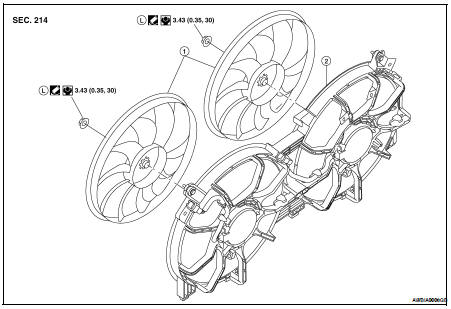
1. Fan blade
2. Fan shroud and motor assembly
REMOVAL
1. Drain engine coolant from the radiator. Refer to CO-35, "Changing Engine
Coolant".
CAUTION:
Perform when engine is cold.
2. Remove CVT control module (if equipped). Refer to TM-430, "Removal and
Installation".
3. Remove battery tray. Refer to PG-139, "Removal and Installation".
4. Disconnect radiator upper hose.
5. Disconnect fan motor connectors.
6. Remove radiator cooling fan assembly.
INSTALLATION
Installation is in the reverse order of removal.
• After installation refill engine coolant and check for leaks. Refer to CO-35,
"Changing Engine Coolant" and
CO-34, "System Inspection".
CAUTION:
Do not spill coolant in engine compartment. Use a shop cloth to absorb coolant.
• Cooling fans are controlled by ECM. For details, refer to EC-1099, "System
Description".
Disassembly and Assembly of Cooling Fan
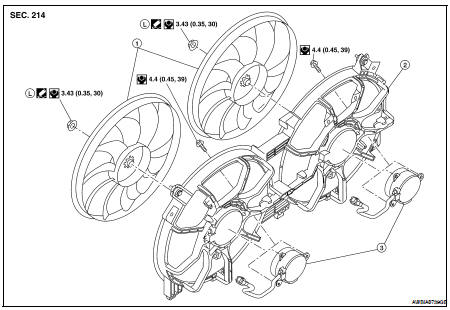
1. Fan blade
2. Fan shroud
3. Fan motor
DISASSEMBLY
1. Remove fan blade nut.
2. Remove fan blade from fan motor.
3. Remove fan motor bolts and remove fan motor from fan shroud.
ASSEMBLY
Assembly is in the reverse order of disassembly.
Removal and Installation
1. Radiator
2. CVT oil cooler hose (if equipped)
3. Radiator hose (upper)
4. Radiator hose (lower)
5. Cooling fan
6. Reservoir tank
7. Reservoir hose
8. Radiator fil ...
Removal and Installation
1. Water pump
2. O-rings
WARNING:
Never remove the radiator cap when the engine is hot. Serious burns could occur
from high pressure
coolant escaping from the radiato ...
Other materials: Power outlet
Instrument Panel
The power outlet is for powering electrical
accessories such as cellular telephones.
It is rated at 12 volt, 120W (10A) maximum.
The power outlet is powered only when the
ignition switch is in the AUTO ACC or ON
position.
CAUTION
The outlet and plug may be hot during
or immedi ...
Moonroof (if so equipped)
Power moonroof
The moonroof will only operate when the
ignition switch is placed in the ON position.
The power moonroof is operational for a
period of time, even if the ignition switch is
placed in the AUTO ACC or OFF position. If
the driver's door or the front passenger's
door is opened during th ...
Seat belt warning light and chime
The driver and front passenger seat is
equipped with an enhanced seat belt reminder
function.
A visual and audible alert will operate at
speeds of approximately 9 mph (15 km/h)
or more under the following conditions:
If the driver seat belt is not fastened.
The front passenger’s seat belt is ...

 Radiator
 Water pump